
Alpharetta Wood Flooring handles hardwood floor repair in Alpharetta, GA and brings 20+ years of fixing floors to every job, serving surrounding cities including Roswell, Milton, Peachtree Corners, Norcross and Sandy Springs. Most floors that look like they need replacing only need a handful of boards, a quieter subfloor or a problem underneath put right.
A good repair is one you cannot find a year later. That means matching species, width and grain, weaving new boards into the floor rather than dropping in a square patch, and dealing with whatever caused the damage so it does not come back. It also means telling you when a repair will show and what it would take to make it disappear.
We look at the whole floor before quoting, because the damaged board is often a symptom. A cluster of cracked boards over a sagging joist, or a spreading gap near an exterior door, is worth understanding before we cut anything out.
Board Replacement That Blends In
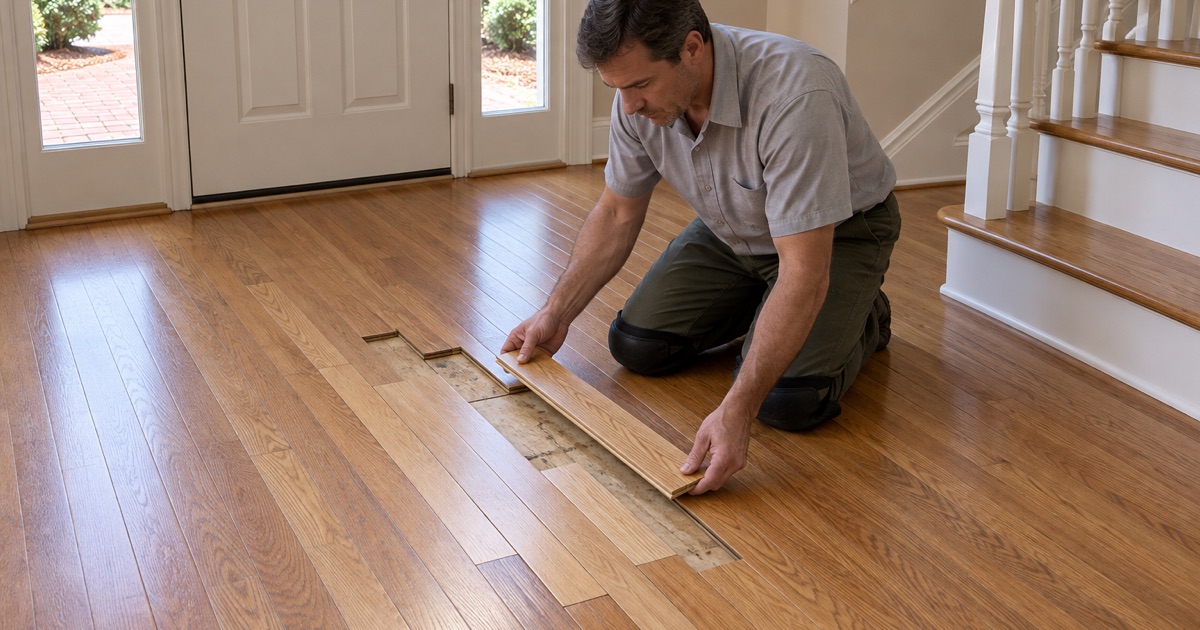
Weaving In New Boards
When a board is damaged, we cut it out along its length and remove the pieces without disturbing its neighbors. New tongue-and-groove boards are fitted in a staggered pattern, so their ends land where the originals would have. The finished repair follows the floor’s own layout instead of forming a visible block.
On larger repairs, we remove boards back to different lengths in each row. That staggered edge is what lets new and old wood read as one floor once sanded and finished.
Matching Species, Width and Grain
Red oak, white oak, heart pine, hickory and maple each have their own grain and color, and even within red oak the grade changes how busy a board looks. We identify what you have and source stock to match, sometimes borrowing boards from a closet to use in a more visible spot. Where a width or thickness is no longer made, we can have boards milled.
New wood is also lighter than wood that has aged under light for years. Red oak darkens and white oak mellows over time, so a repair that looks slightly bright on day one usually settles closer to its neighbors within months, and we plan the stain with that in mind.
Blending the Finish
A new board on a site-finished floor has to be sanded and finished, and new finish rarely matches old finish that has aged for years. Where the repair sits in the middle of a room, the most reliable fix is to refinish that room or run to the next doorway. We tell you honestly how visible a spot repair will be before we do it.
On prefinished floors, the picture is different. If the original product or a close match is still available, a replaced board arrives with its finish already on and can blend in without sanding at all, which keeps the repair small and quick.
Squeaks, Loose Boards and Hollow Spots
Squeaking and Popping Floors
Squeaks come from wood rubbing on wood or on a loose nail as someone walks across it. Where we can reach the underside from a crawlspace or unfinished basement, we shim or fasten the subfloor to the joists. From above, we use screws designed to snap off below the surface and fill the holes to match.
A squeak that moves around the room or gets worse each season may point to a subfloor that is flexing between joists. That repair happens from underneath and stops the noise at its source.
Loose and Lifting Boards
Boards that lift, rock or move underfoot have lost their grip on their fasteners. Sometimes the fix is refastening with flooring cleats or trim screws, and sometimes a board has been damaged by moisture and needs replacing. We check for moisture before refastening anything, because nailing down a board that is still swelling only moves the problem.
Loose boards near exterior doors and sliding doors are common, since rain and tracked-in water reach them first. We check the door threshold and flashing while we are there, because a board that keeps getting wet will lift again however well it is fastened.
Hollow Spots Under Glue-Down Floors
On glue-down engineered floors, hollow spots are areas where the adhesive has let go of the slab. Small areas can be injected with adhesive through tiny holes and weighted while it cures. Larger failures need the boards lifted, the old adhesive removed and the boards reset or replaced.
We tap the floor methodically and mark every hollow area in tape before recommending a fix. That map shows whether the problem is a few isolated spots from a poor adhesive spread or a wide failure that points to moisture rising through the slab.
Gaps, Cracks and Surface Damage
Seasonal Gaps and Board Gapping
Narrow gaps that appear in winter and close in summer are wood reacting to dry heated air, and they need no repair. Board gapping that stays open all year, or that runs wider in one area, usually traces back to a moisture event, a missing expansion gap or boards installed before they acclimated. We find the cause before filling or replacing anything.
Filling gaps with putty on a floor that still moves just cracks the filler out again. For wide, stable gaps in older floors, slivers of matching wood glued into the gaps hold far better.
Cracked, Split and Gouged Boards
A dropped pan, a dragged appliance or a pet crate can crack or gouge a board. Small gouges can be filled and blended during refinishing, while a split board is cut out and replaced. Several cracked boards in one spot tell us to check the joist and subfloor below.
For a deep gouge in a busy room, replacing the board is often cleaner than filling it, because filler never takes stain quite like wood. In a less visible spot, a well-matched fill sanded flush during refinishing is usually hard to find afterward.
Stains That Go Through the Wood
Black pet urine stains and old water stains often soak through the board, so sanding only makes them lighter. Replacing those boards is usually the only real fix. We check the subfloor under a pet stain for odor and rot while the boards are out.
Repairs Underneath the Floor
Sagging or Soft Areas
A soft or bouncy area can mean a damaged subfloor, a cracked joist, or wood weakened by moisture or subterranean termites. We open the floor enough to see the cause and repair the structure before relaying boards. A new board over a soft subfloor fails again quickly.
When we find frass, mud tubes or wood that crumbles under a screwdriver, we stop and ask you to bring in a pest control company before we go further. Repairs wait until treatment is done, so new wood is not laid over an active colony.
Moisture and Crawlspace Problems
Cupped boards, rusted nail heads and musty smells often come from a damp crawlspace. We take moisture meter readings, look under the house and tell you what we find, whether that is a missing vapor retarder, a plumbing leak or poor drainage. Floor repairs last once that moisture is under control.
Sometimes the fix is as simple as a vapor retarder laid over bare soil or a dehumidifier in an enclosed crawlspace. Other times a plumber or drainage contractor is needed first. Either way, we give you readings to take to whoever does that work.
Transitions, Thresholds and Trim
Loose reducers, cracked thresholds and gaps at the quarter round are small repairs that make a big difference to how a floor looks. We replace or refasten them and match the stain to the floor. They are also an easy add-on when we are already working on other repairs.
- 20+ Years on Wood Floors
- Moisture Readings Before Sanding
- Stairs Quoted Tread by Tread