
Alpharetta Wood Flooring installs herringbone wood floors in Alpharetta, GA, along with chevron and wide plank floors, and brings 20+ years of hardwood work to every pattern, serving surrounding cities including Roswell, Milton, Peachtree Corners, Norcross and Sandy Springs. Pattern floors and wide boards are where layout and preparation show most, and they are the jobs we plan most carefully.
A herringbone floor has no hiding place. If the first rows are a fraction off square, the pattern drifts across the room and the error is obvious at the far wall. Wide plank floors are unforgiving in a different way: each board moves more with humidity, so a floor installed too wet or too dry shows it as gaps or cupping. Both reward patience at the start.
We help you choose where a pattern belongs, which species and width suit the room, and how the new floor meets the rest of the house. Those decisions matter as much as the installation itself.
Herringbone Floors
How the Pattern Works
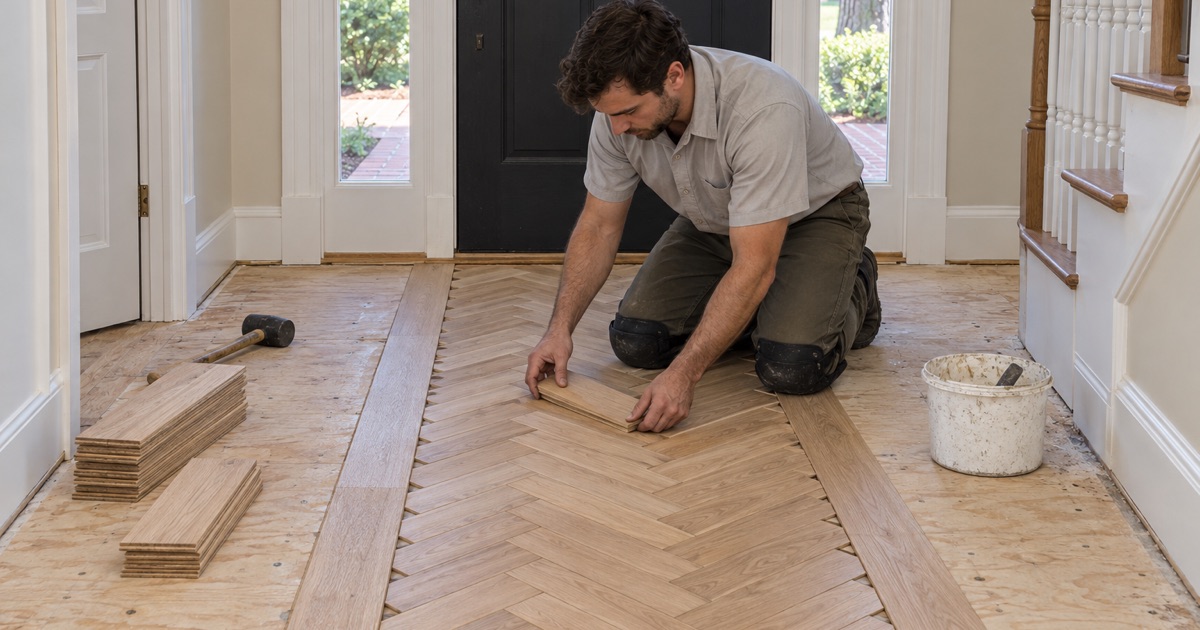
Herringbone is laid from short, rectangular boards set at right angles to each other, forming a zigzag that runs down the length of the room. Each board butts against the side of its neighbor, which is why the pattern looks woven. The boards come in left-hand and right-hand versions, since the tongue and groove must fall on opposite sides.
The pattern can run with the room or at an angle to it, and the choice changes how the space feels. Running the zigzag toward a window or down a hallway draws the eye along it.
Layout and Centerlines
We start by finding the centerline of the room, or of the view you care about most, and snap a layout that squares the pattern to it. A few test rows are laid dry before any boards are fastened. That work takes time up front and is the difference between a pattern that runs true and one that wanders toward a wall.
Most rooms are not perfectly square, so we measure the walls against the layout before committing. Where a wall runs out of line, we decide with you where the small correction should fall, usually under a border or along the least visible edge.
Borders and Edges
Where the pattern meets the walls, boards are cut at angles to fill the edge. Many herringbone floors are framed with a border of straight boards, which gives a clean line at the walls and hides small variations in the room’s shape. A border also makes a natural transition into rooms with straight-lay flooring.
Borders can be a single board or several rows, in the same species or a contrasting one. A contrasting border outlines the room strongly, while a matching one frames the pattern quietly, and we show you both on samples before deciding.
Chevron Floors
How Chevron Differs
Chevron boards are cut at an angle on each end so they meet in a clean point, forming a continuous V rather than herringbone’s stepped zigzag. The effect is more formal and more directional. Chevron requires boards manufactured or cut specifically for the pattern.
Where Chevron Suits Best
Chevron works well in long spaces such as hallways, galleries and open living areas, where the points lead the eye. In a small, square room, it can feel busy. We lay out samples so you can see the scale of the pattern in the space before committing.
Chevron also rewards a calm species. White oak with a natural or light stain lets the pattern carry the room, while a busy grain can compete with it.
Wide Plank Floors
Solid or Engineered Wide Plank
Wide plank boards show more of each board’s grain and color, which gives a room a calm, open look. Solid wide boards move more across their width as humidity changes, so they need careful acclimation and a stable indoor climate. Engineered wide plank, with its cross-layered core, is more stable and is often the better choice, especially over a slab or on a terrace level.
Species and Character
White oak is the most popular wide plank species, prized for its tight grain and its response to natural and gray finishes. Hickory adds strong color variation, and heart pine brings a historic look. Character grades with knots and mineral streaks suit wide boards particularly well.
Mixing widths is another option, laying two or three board widths in a random pattern for an older, hand-built look. It uses more of each log and suits farmhouse and rustic interiors, while a single width reads cleaner and more contemporary.
Fastening Wide Boards
Wide solid boards often need more fasteners, and sometimes glue as well as nails, to keep them flat. We follow the manufacturer’s instructions and the NWFA Installation Guidelines for the width and product. Moisture readings in the boards and subfloor are recorded before installation.
Finishing Pattern and Wide Plank Floors
Site-Finished or Prefinished
Pattern floors are often installed unfinished and sanded in place, which flattens the small differences between boards and gives a seamless surface. Prefinished herringbone and wide plank are also available and go in without sanding. We explain the tradeoffs for your room and schedule.
Sanding Across Two Grain Directions
In a herringbone or chevron floor, the grain runs in two directions, so any sanding scratch that follows one direction runs across the other. We sand with that in mind and finish with an orbital sander to remove swirls. Stain then goes on evenly across the whole pattern.
Stain and Sheen
Pattern floors often look best in natural or light stains that let the pattern show, although dark colors can look dramatic in a formal room. We lay stain samples on your floor so you can see how the color reads across both directions of the pattern.
- 20+ Years on Wood Floors
- Moisture Readings Before Sanding
- Stairs Quoted Tread by Tread