
Alpharetta Wood Flooring has handled wood flooring in Marietta and across the north metro for more than 20 years, and the work we are called for most here is the large kind: whole floors lifted after a leak or a storm, carpet pulled up for hardwood, and site-finished oak sanded back to bare wood. Those are the projects where an owner has real questions to ask before the first board comes up.
Our part is the floor itself. We read every affected room with a moisture meter, find where the water came from, and write up what we see so the numbers behind a repair are on paper rather than in someone’s memory. When the source is fixed and the subfloor is dry, we plan the replacement, the refinish or the new install around what the house actually needs.
What we do not do is give permit answers. Large interior projects can sit under local rules, and the people who apply those rules work for the local government, not for a flooring crew. This page covers what the rules say, how we approach water-damaged floors, and what changes about floor work in the homes we see most often.
Marietta’s 50 Percent Floodplain Rule and Big Floor Projects
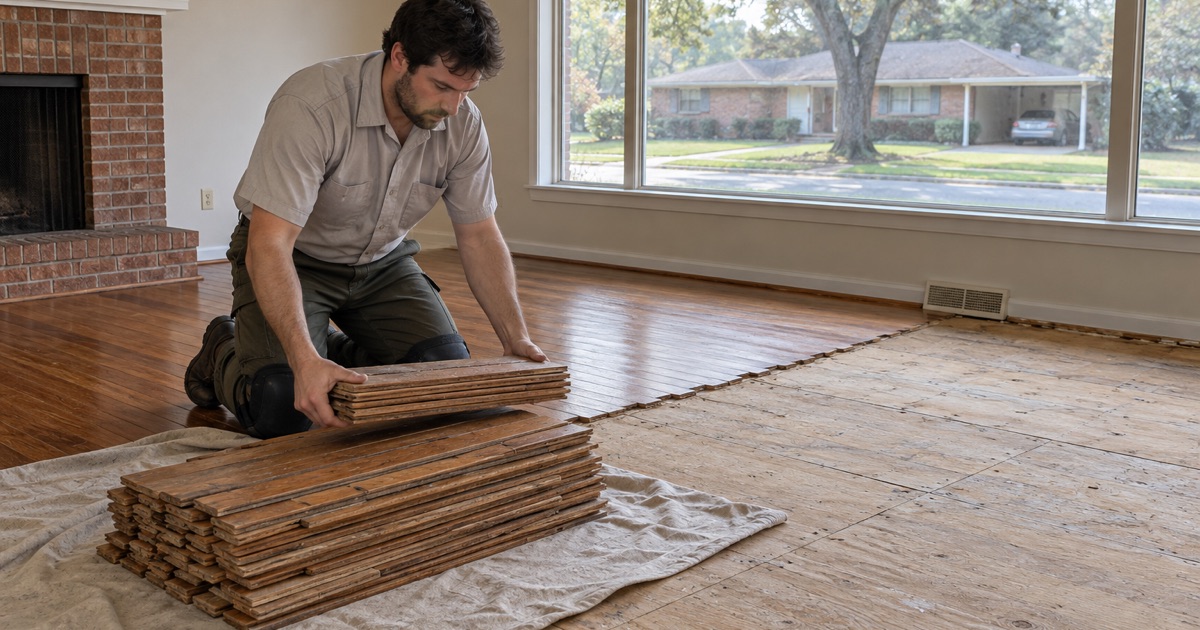
Marietta runs its own floodplain management program through the city’s Public Works and Engineering staff. Two of its rules matter to anyone planning a large interior project in a building that sits in a floodplain, and a third sets a baseline for anything new. We quote them as the city publishes them, because a paraphrase is how a rule gets bent into something it never said.
New Development Needs a City Permit
The city’s floodplain page states that all new development within a floodplain needs a permit from the City of Marietta. That is the city’s own line, and it is the reason we raise the floodplain question before scheduling any project that goes beyond a refinish. Whether a given job counts as development under that rule is the city’s call to make, not ours.
So on a large job we ask early whether the house is in a mapped floodplain, and if the owner does not know, we suggest finding out before materials are ordered. A delayed start costs far less than a floor installed and then questioned. The answer comes from Marietta’s floodplain staff, and we would rather an owner hear it from them than from a guess.
The 10-Year Fair Market Value Rule
The city also says that if redevelopment costs equal or exceed 50 percent of the fair market value of the primary structure for any 10-year period, any property preexisting within the floodplain will be required to be brought up to code. The window is ten years rather than one project, so a kitchen remodel last year and a floor this year can sit in the same period.
We cannot tell an owner how the city will tally a particular floor project against that figure, and nothing we have read from the city settles it. What we can do is hand over an itemized estimate with every line separated, so the owner has clean numbers to bring to the city before committing. The decision belongs to the floodplain administrator.
When Damage Reaches Half the Structure’s Cost
A second rule covers damage rather than improvement. For any property on which the primary structure takes damage equaling 50 percent or more of its cost, the city says the entire property will be required to come up to code. After a serious flood, that rule can shape the whole repair before anyone gets around to discussing flooring.
That is why we tell owners with major flood damage to speak with the city before they settle on a floor. Our documentation of wet rooms, damaged boards and subfloor readings can support that conversation, but it is not a damage determination. We measure and record; the city decides what the building needs.
Looking for wood-flooring closer to North Druid Hills? See North Druid Hills Wood-Flooring.
Replacing Floors After Water Damage
Trace the Water, Then Dry It
Water under a wood floor comes from more places than a creek. A failed supply line, a leaking dishwasher and storm water through a door all leave the same early symptoms: cupping as the board bottoms swell, crowning if someone sands too soon, and buckling where the floor has nowhere left to go.
Before a single board is replaced, we find where the water came from and confirm it has stopped. Then the room dries, often with a dehumidifier running, while we take moisture meter readings across the floor and the subfloor. Replacing boards over a wet subfloor only moves the damage into brand-new wood.
Room-by-Room Records for the Adjuster
Insurance adjusters work from evidence, so we write the floor up room by room: where the water reached, what the readings showed, which boards are cupped, stained or loose, and where hollow spots or board gapping appeared. Photographs go alongside the readings so the record still holds up after the damaged floor is gone.
That same record serves an owner who needs numbers for the city’s floodplain staff. An estimate that separates removal, subfloor repair, new boards, stairs and finish is easier to review than a single total. We keep each line distinct for that reason, without suggesting what any reviewer will conclude from it.
Choosing What Goes Back Down
Once the floor is dry, the choice is between weaving in matching boards and replacing whole rooms. Where damage is limited, board replacement with matching stock followed by a sand and refinish can blend the repair into the existing floor. Water stains that have gone black in red oak or white oak usually mean the board has to go, since sanding rarely lifts them.
For owners in flood-prone parts of the city, engineered wood with a sound wear layer is a common choice over solid hardwood in lower rooms and terrace-level floors. We talk through Janka hardness, finish type and acclimation time before ordering. What we will not do is rush an install to meet a date while the readings are still high.
The Creeks That Rise in Marietta and Flood Insurance
Floodplain questions here start with local water. Several creeks begin inside or beside the city before running toward the Chattahoochee River, which is part of why the rules above matter to so many owners.
Sope and Rottenwood Creeks
Sope Creek originates in east Marietta and flows into the Chattahoochee River, and Rottenwood Creek starts in south Marietta and runs to the same river. Both were the subject of a 2002 USGS water-quality and ecological assessment. For a homeowner, the point is simply that these streams begin close to home rather than somewhere far upstream.
When a house near either creek has had water inside, we treat the job as a possible floodplain project until the owner confirms otherwise. That means asking the location question early and keeping our estimate itemized. It costs nothing to check, and it keeps the floor schedule from running ahead of a conversation the owner may need to have with the city.
Ward Creek, Noses Creek and City Stormwater
Ward Creek begins within Marietta itself, and Noses Creek flows from between Kennesaw and Marietta. Stormwater inside the city limits is handled by the City of Marietta, and Cobb County’s water system notes that city customers are not billed the county stormwater fee because the county does not provide that service to them.
That matters when water arrives from outside after a storm. A drainage problem on a street or a lot is a question for the city’s stormwater staff, not for us and not for the county. We fix the floor once the source is handled, and we point owners toward the city for anything that starts beyond their own walls.
Flood Insurance Through the NFIP
Marietta participates in the National Flood Insurance Program, which makes federally backed flood insurance available for all eligible buildings, whether they are in a floodplain or not. A search excerpt from the city also describes a Community Rating System Class 8 rating as of October 2013, though we have not confirmed the current class.
What a flood policy pays toward a floor is between the owner, the insurer and the adjuster, and we do not predict it. Our job is the documentation: readings, photographs, the extent of damage in each room and an itemized replacement estimate. Good records shorten the claim conversation, whatever the answer turns out to be.
Floor Work Across Marietta’s Mixed Housing
Housing in Marietta ranges from detached homes to townhouses and large apartment buildings, and the floor work changes with it. The era a home was built in and who lives in it both shape the jobs we are asked to quote.
Homes From the 1980s and Later
About 25.6 percent of Marietta’s housing was built in the 1980s, the largest single decade, and another 25.2 percent dates from 2000 or later. Many of those homes carry builder-grade carpet over the subfloor, or site-finished oak worn into traffic lanes and faded near windows. Both are good candidates for work that keeps the structure and changes the surface.
Where there is solid hardwood, we check the wood left above the tongue before recommending a sand and refinish, since a floor sanded too often has little to give. Where there is carpet or vinyl plank, we pull the carpet pad and tack strip, check the subfloor, and run hardwood through the rooms and up the stairs, quoted tread by tread.
Rentals and Move-Out Estimates
Just over half of Marietta’s occupied homes are rented, about 52.8 percent. For landlords that means turnover, and floors take the wear first: pet urine stains, water stains by sinks, deep scratches and sun fade. We write itemized damage estimates a landlord can set against the move-out inspection list, room by room.
Where a floor can be saved, a screen and recoat or a full refinish usually costs far less than replacement. Where it cannot, we replace only the damaged sections with matching boards when the stock allows. Either way the estimate separates ordinary wear from damage, which is the distinction a landlord needs when reviewing a deposit.
Older Homes and Lead-Safe Sanding
About a third of Marietta’s housing, 33.3 percent, was built before 1980. Federal lead-safe rules reach homes built before 1978, so we confirm the build year and look at painted trim, baseboards and stair parts before any sanding in an older house. That check happens before the drum sander comes off the truck.
For clear finishes we choose by federal VOC category rather than by the number that applies to opaque floor coatings, and we lay stain samples on your own floor so you see the color in your own light. Waterborne polyurethane, oil-modified polyurethane and hardwax oil each wear differently, and we explain the tradeoffs before you pick a sheen level.
- 20+ Years on Wood Floors
- Moisture Readings Before Sanding
- Stairs Quoted Tread by Tread










