
Alpharetta Wood Flooring handles wood flooring in Roswell for homeowners who would rather keep a sound floor than replace it, and we have been sanding, repairing and laying hardwood for more than 20 years. Most of what we see here is site-finished oak that has worn through its finish in the traffic lanes, gapped along the kitchen run, or picked up water stains near a sink, and most of it can be brought back.
Every job starts with measurement rather than a sales pitch. We read the boards with a moisture meter, check how much wood is left above the tongue, and look at the build year before any sander touches the floor. That tells us whether a floor wants a screen and recoat, a full sand and refinish, a few woven-in boards, or a new floor altogether.
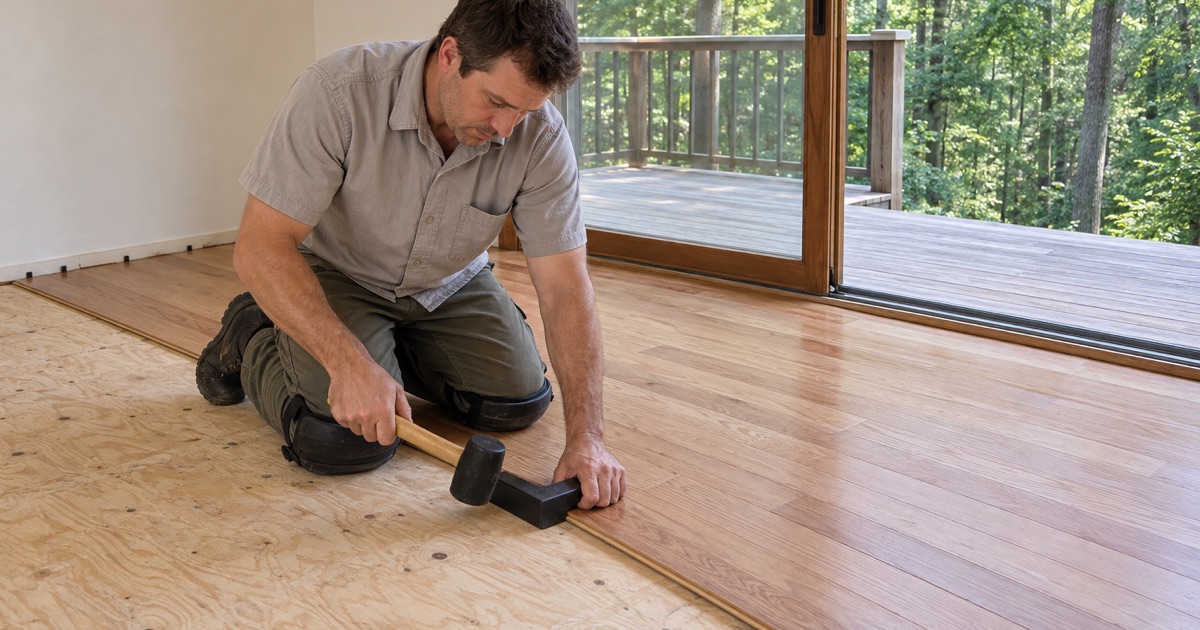
When new wood is the right answer, we lay it room by room and step by step, stairs included, and we lay stain samples on your own floor so you judge color in the light you actually live with.
Floors Along Roswell’s Chattahoochee Edge
Roswell sits in northern Fulton County, and its southern boundary follows the Chattahoochee River. Big Creek and Vickery Creek run through the city on their way toward it, and the city counts over 900 acres of parkland, including access to the Chattahoochee River National Recreation Area at Vickery Creek. That water shapes how we plan work on some Roswell lots, even though most of what we do happens entirely indoors.
What the Metropolitan River Protection Act sets out
The Atlanta Regional Commission describes the Metropolitan River Protection Act as protecting a 48-mile stretch of the Chattahoochee between Buford Dam and Peachtree Creek by creating a 2,000-foot buffer along both banks. The standards include a 50-foot undisturbed vegetative buffer along the river and its impoundments, a 35-foot undisturbed buffer along flowing streams in the corridor, and a 150-foot impervious surface setback along the river. Roswell’s zoning carries a River Corridor (-RC) overlay intended to clarify where the commission’s jurisdiction reaches.
What it says and what it does not say
ARC states that a review is required when a proposal increases the amount of land disturbance or impervious surface over existing or approved amounts. That wording is about ground and hard surfaces. The commission’s page says nothing either way about refinishing a living room or replacing boards in a hallway, and we will not tell you otherwise. Where a flooring project is part of a larger plan, such as an addition, a new deck or a paved path to the water, that outside work is the piece that can draw corridor review, and we would want you to confirm it with the City of Roswell and ARC before the schedule is set.
Why it still matters to a floor crew
On a river-view lot, the practical questions are simple ones. Where does the truck park, where does the dust collection run, and where do we stage boards without laying anything new on the ground? We keep material in the garage or on existing drives and walks, and we never clear or pave anything to make room for a floor job.
Looking for wood-flooring closer to Milton? See Wood-Flooring Services in Milton.
Refinishing Roswell’s 1980s and 1990s Houses
Roswell’s housing stock has a clear center of gravity. Of the 37,439 housing units the Census Bureau counts in the city, 12,295 were built in the 1980s and 7,680 in the 1990s, so 53.4 percent went up between 1980 and 1999. And 71.9 percent of occupied units are owner-occupied, which means most of the floors we look at belong to people planning to stay with them for years.
Site-finished oak that still has wood left
Houses of that era very often carry site-finished red oak or white oak in the foyer, dining room and kitchen, with carpet over the rest. After three decades the finish is gone in the traffic lanes, the color has drifted toward orange oak, and sun fade marks where rugs used to sit. None of that means the floor is finished. We pull a floor register or a threshold, measure what remains above the tongue, and only then decide whether a full sand through the grit sequence is safe.
Screen and recoat versus full sanding
If the finish is dull but intact and the wood is not gray or stained, a screen and recoat adds a fresh coat of polyurethane without cutting into the wood. If there are pet urine stains, deep scratches or bare spots, the floor needs a drum sander, an orbital sander along the edges, and a new finish. We run dustless sanding equipment on both, and we use water popping before stain when an even, deeper color matters.
Finish choices, explained plainly
We talk through waterborne polyurethane, oil-modified polyurethane and hardwax oil in terms of cure time, sheen level and how each will age in your house. When we compare clear finishes, we compare them by their federal VOC category under 40 CFR 59 Subpart D rather than a floor-coating limit that applies to opaque coatings. And while most Roswell houses from these decades post-date the cutoff, we check build year and painted trim on any older home, because the EPA RRP Rule reaches homes built before 1978.
Carpet out, hardwood in
Many owners in these houses want the carpet gone from bedrooms and the upstairs hall. We pull carpet pad and tack strip, check the subfloor for squeaks and soft spots, and lay solid hardwood or prefinished boards that tie into the existing oak with the right reducer or a woven transition. Builder-grade laminate and luxury vinyl plank come out the same way.
Vickery Creek, Big Creek and Lower-Level Floors
A city laced with creeks and bordered by a river is a city where moisture deserves attention on every floor job. We do not assume anything about your lot’s drainage, but we do measure, because humidity and water are the most common reasons a Roswell floor misbehaves.
Cupping, crowning and a moisture meter
When boards cup in a humid Georgia summer, the edges rise because the underside holds more moisture than the top. Sand a cupped floor flat too early and it crowns once it dries, leaving a hump down every board. We read the floor and the subfloor with a moisture meter, find the source below, and let a dehumidifier or a repaired vapor retarder do its work before any sanding starts. Buckling and hollow spots get the same treatment: cause first, repair second.
Terrace-level rooms and engineered wood
Many Roswell houses built into a slope have a terrace-level floor that sits partly below grade. Solid hardwood does not belong there. We match engineered wood to those rooms, glue-down engineered or a floating floor depending on the subfloor, with a wear layer thick enough to sand later and an expansion gap around the edges. The color can be matched to the oak upstairs so the house still reads as one.
Leaks, storms and adjusters
Water from a supply line, a dishwasher or a storm gets traced, dried and measured before we replace a single board. We document each room with readings and photos so your adjuster has a clear record, then weave in matching boards and blend the finish.
Planning a Floor Project in Roswell
Most of our Roswell jobs follow the same sequence: a site visit with meter readings, a written plan, samples on the floor, then the work. A few local situations change that order, and it helps to know about them in advance.
HOA approval and neighborhood rules
Some Roswell subdivisions and townhouse communities have their own rules about flooring, underlayment or work hours. Those come from your own declaration under the Georgia Property Owners’ Association Act or the Georgia Condominium Act, not from state law, so we ask you to confirm written approval before we start rather than learn about it mid-job.
Termite damage and closing dates
With 20,668 owner households in detached houses, a lot of Roswell homes change hands, and a wood infestation report sometimes turns up damaged boards days before closing. Once your pest control company has treated for subterranean termites, we cut out the damaged boards, check the joist and subfloor for frass and mud tubes, and weave in matching stock. We never fill termite damage or cover it over, and we work to the closing date you give us.
Stairs, priced one tread at a time
A staircase is not a square-foot job. We quote stair treads, stair risers and stair nosing individually, because a straight run and a winding stair with a landing take very different amounts of labor. Replacing carpeted stairs with hardwood treads is one of the most requested upgrades in houses of this era.
Rental floors between tenants
For landlords, we write itemized floor-damage estimates that line up against your move-out inspection list, with each room and each defect priced separately. That gives you a clean record for the deposit conversation and a clear scope for the repair.
Whatever the floor, the visit starts the same way: we look, we measure, and we tell you what the wood can still take before anyone quotes a price.
- 20+ Years on Wood Floors
- Moisture Readings Before Sanding
- Stairs Quoted Tread by Tread










