
Alpharetta Wood Flooring has handled wood-flooring in Sandy Springs for more than 20 years, and a growing share of that work now happens in apartments and condos between one lease and the next. We sand, refinish, patch and replace hardwood for the owners and managers who have to hand a clean, level unit to the next tenant, usually against a date that does not move.
Our work starts with a reading, not a sander. We put a moisture meter on any board that has cupped, crowned or stained, find where the water came from, and only then decide whether the floor needs a screen and recoat, a full sand and refinish, a few woven-in boards or a new floor. That order keeps a fast turnover from becoming a second repair.
For landlords, we write the estimate the way a move-out list reads: room by room, item by item, with the damage and the fix side by side. It gives an owner something concrete to set against the move-out inspection, and it gives a property manager a scope to schedule. The sections below walk through what a rental floor has to show when the inspector arrives.
What the City’s Rental Unit Checklist Says About Floors
Sandy Springs runs a Multifamily Rental Housing program, usually shortened to MRH, and the city defines its reach plainly: any building with three or more rental units used as residences or sleeping spaces. Ordinance updates approved on September 5, 2023 changed the rhythm. Since 2024, every MRH unit is inspected every year by a third-party Certified Building Inspector, instead of the inspections being spread out over five years.
Who the Program Reaches
The program is about apartment buildings, condo rentals and flats in buildings of three or more rental units. It does not reach an owner-occupied house, and it does not reach a duplex or a single rented home. That still covers a great deal of the city. Census figures put 49.8 percent of occupied homes in Sandy Springs in renter hands, which is half the city’s households.
Those renters are overwhelmingly in the buildings the program targets: 88.8 percent of renter households live in buildings of three or more units. For a flooring crew, that means most of the rental floors we see here sit inside the MRH definition, and most of them will be walked by an inspector with a clipboard at least once a year from now on.
Item 13: Level Floors in Good Condition
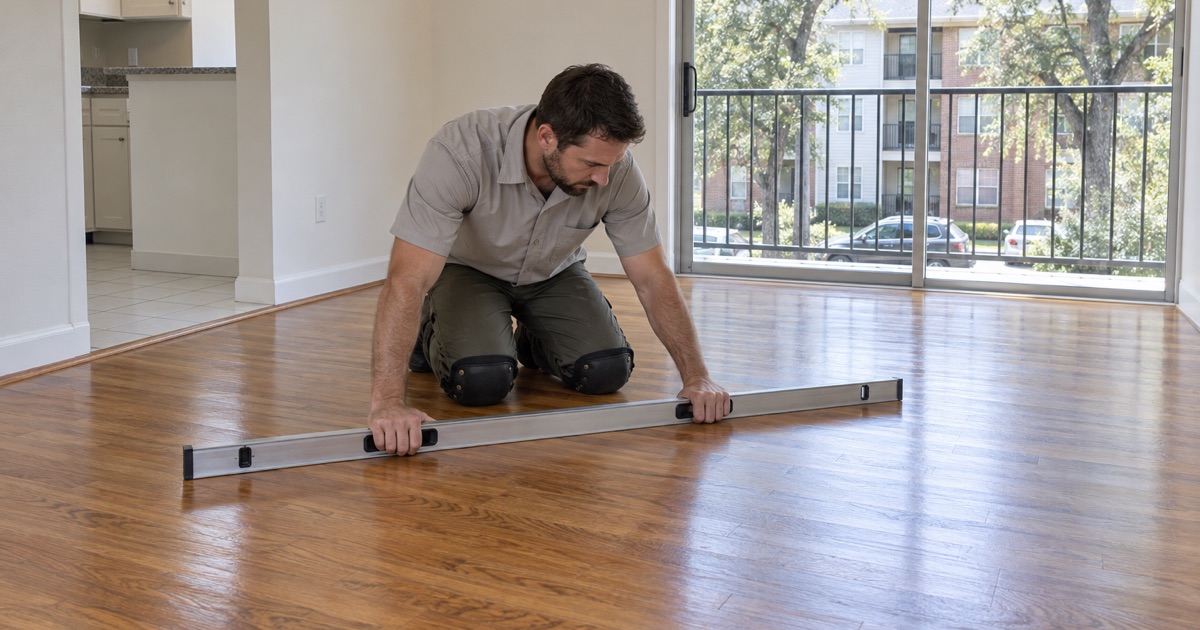
The city’s Rental Unit Inspection Report runs to 98 numbered items. Item 13 is the one written about floors: interior floors and ceilings are level and in good condition, and the inspector is told to check that there are no sags, humps or cracks. That is a visual and underfoot test, and hardwood that has moved, dipped or split fails it in a way a tenant also notices.
Item 17: No Water Staining
Item 17 asks for no evidence of water staining on the unit’s ceilings, walls or floors. On hardwood, water leaves a gray or black ring where it soaked into the grain, and a finish coat does not hide it. Nearby items ask that the unit show no mold or mildew and that stairs and landings be structurally sound and in good condition, which puts stair treads on the same list.
Where We Fit, and Where We Don’t
The inspection itself belongs to the Certified Building Inspector the owner or manager hires. We do not perform it, we do not sign it and we cannot promise how it comes out. What we do is the floor work before it: fixing what item 13 or item 17 would flag, and handing over a written record of what was repaired and why.
Looking for wood-flooring closer to Suwanee? See Suwanee Wood-Flooring.
Sags, Humps, Cracks and Water Stains Inspectors Flag
Each of the words on item 13 points to a different cause under the boards, and the fix depends on the cause. A sag, a hump and a crack can sit in the same room and need three different repairs. That is why we read the floor before we quote it, instead of pricing a whole unit as one refinish.
Sags and Hollow Spots
A sag usually starts below the hardwood: a subfloor panel that has softened after a leak, fasteners that have let go, or a joist that has moved. Hollow spots that sound drummy underfoot are often glue-down engineered floors that have released. We open the area, find which layer failed, repair that layer, and then relay or replace the boards over it so the floor reads level again.
Humps: Cupping, Crowning and Buckling
Wood that takes on moisture swells. Cupping raises the board edges, crowning raises the centers, and buckling lifts boards clear off the subfloor. All three read as humps to an inspector walking the unit. Sanding a crowned floor flat while it is still wet leaves it cupped once it dries, so we meter first, find and stop the source, dry the floor, and sand only when the readings settle.
Cracks, Gaps and Split Boards
Board gapping, split tongues and cracked boards at doorways show up after years of tenant traffic and seasonal movement. Small seasonal gaps are normal in solid hardwood; a split board or a lifting edge is not. We cut out damaged boards and weave in matching stock rather than filling the crack, so the repair holds its shape and does not open back up before the next inspection.
Leaks at Dishwashers, Washers and Water Heaters
The checklist also carries leak items for dishwashers, washing machines, water heaters, sinks and tubs, and those fixtures are where rental floors stain first. A slow supply-line drip under a dishwasher can blacken the boards in front of it long before anyone sees a puddle. We trace the water, dry and measure the floor, and document the damage room by room for the owner or the adjuster.
Plumbing systems get their own inspection every five years, but a floor stain does not wait for that cycle. Once the leak is fixed, boards with shallow graying can sometimes be sanded out, while deep black staining means cutting out and replacing boards. We tell you which it is before any sanding starts, because sanding a board that has to come out anyway is wasted money.
Refinishing and Replacing Floors Between Tenants
A vacant unit is the only time most rental floors can be worked properly, so turnover is when we do the heavy work. The choice between a recoat, a full refinish, a partial repair and a new floor comes down to what the wood has left, what the last tenant did to it, and how many days sit between move-out and move-in.
Screen and Recoat or a Full Sand
The housing stock here leans toward the late twentieth century: 24.6 percent of units were built in the 1980s, the largest single decade, and 31.7 percent date from 2000 or later. Much of the site-finished oak laid in the 1990s and 2000s can be sanded and refinished rather than torn out. We check how much wood remains above the tongue before committing to a full sand.
Where the finish is worn through only in traffic lanes and the wood itself is sound, a screen and recoat restores the surface in far less time than a full sand. Where there are pet urine stains, deep scratches or sun fade that runs into the wood, a full sand with a proper grit sequence is the honest answer. We use dustless sanding in occupied buildings so neighbors are not living in the dust.
Replacing Carpet, Laminate and Vinyl Plank
Many units were turned over years ago with builder-grade carpet, laminate or luxury vinyl plank that has since worn, peeled or swollen at the seams. We pull the carpet pad and tack strip, check the subfloor, and lay hardwood in its place. Solid hardwood suits most upper floors; engineered wood with a real wear layer is what we use wherever the floor sits below grade.
Stairs, Treads and Finishes
Because the checklist asks that stairs and landings be structurally sound and in good condition, we treat interior stairs as part of the unit, not an afterthought. We quote stairs tread by tread, since a staircase is not priced by the square foot, and replace loose treads, split nosing and worn risers individually. Stairs often matter as much as the living room floor.
For clear finishes we choose waterborne or oil-modified polyurethane by its federal VOC category, which matters when a new tenant is moving in days later. Before sanding in an older building, we check the build year and any painted surfaces, because federal lead-safe rules reach homes built before 1978. Stain samples go down on your own floor, in the unit’s own light, before a color is chosen.
Planning Floor Work Around the Annual Inspection Calendar
An annual inspection turns floor repair from something that can wait for the next vacancy into something with a deadline. The owners and managers who handle it best book floor work early, when units are empty, rather than finding item 13 or item 17 on a failed report and scrambling for a crew in the last weeks of the cycle.
The Current Cycle’s Dates
The city’s MRH page sets the dates for this cycle. All annual inspections must be completed by December 31, 2026, and all inspections must pass by March 31, 2027 for the owner to receive the MRH Compliance Certificate. That certificate is submitted with the business license renewal, so a failed floor item can reach further than one unit.
The gap between those two dates is the window for correcting anything an inspector flags. A floor repair that needs drying time, board replacement and finish cure can use a good part of it. We would rather see a floor in the fall, before the inspection, than in the new year with a correction list and a March deadline behind it.
Working Vacant Units in Sequence
The checklist requires extermination before a vacant unit is re-leased, and the floor has to fit into the same turnover. We coordinate with the manager so sanding, finish and cure time land between move-out and move-in, and the new tenant never walks on a soft finish. On larger turnovers we stage units so one crew keeps moving from door to door.
That sequencing matters most in the city’s big buildings. Buildings of 50 or more units hold 20.7 percent of Sandy Springs housing units, and an owner of one may face several vacancies in a single inspection cycle. We keep one itemized sheet per unit, so the manager can see at a glance which floors are finished, which are curing and which still need boards.
Condo Rentals and HOA Approval
A rented condo sits inside two sets of rules: the city’s MRH checklist and the association’s own declaration. Any interior flooring rule comes from that declaration, not from state law, and many associations govern hard flooring over another unit. We confirm the HOA’s written approval before work starts, so a floor that passes the city’s inspection does not start a dispute with the board.
- 20+ Years on Wood Floors
- Moisture Readings Before Sanding
- Stairs Quoted Tread by Tread










