
Alpharetta Wood Flooring brings more than 20 years of work to wood-flooring in Suwanee, and a growing share of it falls into one category: floors meeting their first serious maintenance decision. A house finished in the late 1990s has carried a quarter century of foot traffic, furniture and afternoon sun across the same boards. We help owners work out what those boards need next.
The question is rarely whether a floor looks tired. It is whether the floor a house was built with can be sanded and refinished for another long run, or whether it has reached the point where replacement is the better use of the budget. We answer that with measurements rather than guesses: moisture readings, a check of the wood left above the tongue, and a close read of every damaged area.
This page walks through what a first refinish or first replacement looks like in a Suwanee subdivision house, how we judge which path fits, and what to settle with an association before a sander arrives. If the floors in your house have never been redone, or were redone once long ago, most of what follows applies directly to your rooms.
What Suwanee’s Plan Said About Neighborhoods Aging
A Vision of Neighborhoods Aging Gracefully
Suwanee’s 2030 Comprehensive Plan set out a vision for the city’s residential areas: ‘Neighborhoods will be attractive and aging gracefully, with most single-family detached homes being 30-45 years old.’ That line was a goal written into the plan’s Community Agenda, not a count of houses. It pictured a city whose subdivisions would mature in place rather than be cleared and rebuilt.
What the vision leaves unsaid is how a house actually ages gracefully. Roofs, windows and mechanical systems get replaced on their own schedules, and floors run on one too. A neighborhood that stays attractive as it matures is one where owners keep up the surfaces people walk on every day, and hardwood is one of the few that can be renewed rather than simply swapped out.
The 1990s Build Decade Reaches That Stage
Census figures show where that vision is now landing. The American Community Survey’s 2024 five-year estimates count 8,584 housing units in Suwanee, and 2,656 of them, or 30.9 percent, were built from 1990 through 1999. That makes the 1990s the city’s largest build decade, and those houses now range from their late twenties to their mid-thirties in age.
Behind them comes a second wave. Another 29.0 percent of units date from 2000 through 2009, so the next decade’s houses are reaching the same point on a slightly later schedule. Taken together, 84.4 percent of Suwanee’s housing units were built between 1990 and 2019, which means a large share of the city’s floors belong to one broad generation of construction.
Very Little Housing Predates 1980
Only 2.8 percent of Suwanee’s units were built before 1980. That matters for floor work in two ways. Most houses here have never been through the long cycle of repeated sanding that thins floors in much older towns, and very few fall under the federal lead-safe rules that apply to homes built before 1978.
We still check the build year and look at painted surfaces before sanding any house, because the EPA RRP Rule reaches the older homes that do exist, and a painted baseboard or stair riser can be the part our work disturbs. For most Suwanee houses the check takes minutes, but we run it every time rather than assuming a subdivision’s age from the street.
Looking for wood-flooring closer to Sugar Hill? See Wood-Flooring in Sugar Hill.
The First Full Refinish on a House’s Original Floors
Reading Traffic Lanes, Sun Fade and Color Shift
A floor that has never been refinished tells its history plainly. Traffic lanes run from the kitchen to the back door and down the main hall, where the finish has worn through to gray, unprotected wood. Rooms facing a big window show sun fade, and red oak under an aging clear coat often drifts toward the orange oak color many owners now want gone.
A screen and recoat, which lightly abrades the surface and adds a fresh topcoat, can extend a floor whose finish is dull but intact. Once traffic lanes reach bare wood, pet urine stains turn dark, or water stains soak into the grain, a recoat only seals the damage in. That is when a full sand down to raw wood becomes the right call.
Checking the Wood Above the Tongue First
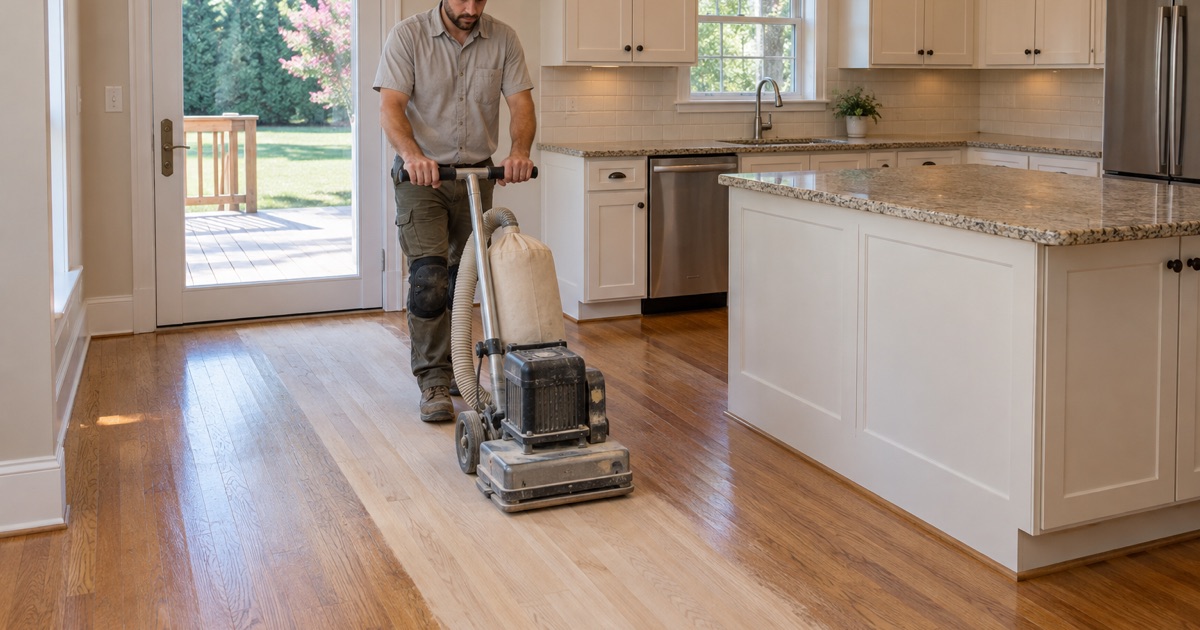
Before a drum sander touches the floor, we pull a floor register or examine an exposed edge to see how much wood remains above the tongue on solid hardwood. A floor that has never been sanded typically has the most room it will ever have, but we confirm that instead of assuming it. A floor sanded too thin exposes its tongue and fasteners and cannot be refinished again.
Engineered floors call for the same caution with different limits. The engineered wear layer on some products can take a full sanding and on others cannot take one at all, so we identify the product before quoting. Our grit sequence then runs coarse to fine, with the drum sander on the field, an orbital sander along the edges, and dustless sanding equipment keeping the house livable.
Choosing Stain and a Clear Finish
Owners redoing a floor for the first time often want a different look than the builder picked decades earlier. We lay stain samples directly on your floor, in your own rooms and your own light, so the color is judged where it will actually live. Water popping before staining opens the grain for deeper, more even tones on red oak and white oak alike.
The topcoat is the second decision. Waterborne polyurethane stays clearer and dries faster, oil-modified polyurethane adds warmth, and hardwax oil gives a low-luster look that spot-repairs easily. We choose clear finishes by their federal VOC category under 40 CFR 59 Subpart D rather than the floor-coating limit meant for opaque coatings, then settle the sheen level with you.
When Replacement Beats Another Refinish
Cupping, Crowning and Water Damage
Some floors cannot be sanded back into shape. Cupping, where board edges rise above their centers, usually means moisture is reaching the wood from below or from a leak. Sanding a cupped floor flat before that moisture is dealt with leaves a floor that crowns as it dries, its centers standing higher than its edges and its finish ground thin.
So we read the floor with a moisture meter first and trace the source, whether that is a failed supply line, a dishwasher or water driven in by a storm. The area is dried and measured again before any board replacement starts, and each room is documented for the adjuster. Only then do we decide whether boards come out or can stay.
Termite Damage Found at a Sale
Houses from the 1990s have been standing long enough for subterranean termites to find some of them. Frass, mud tubes along a foundation wall, or boards that sound hollow underfoot can all point to termite damage in the flooring. We work after the pest control company has treated, cutting out damaged boards and weaving in matching stock rather than filling or covering the damage.
Much of this surfaces when a house goes on the market and the Official Georgia Wood Infestation Inspection Report notes damaged flooring. We help sellers get the repair finished against the closing date, working alongside the termite letter and any termite bond already on the house, so the floor is not the thing that holds up the sale.
Replacing Carpet, Laminate and Vinyl Plank
Plenty of Suwanee houses still carry builder-grade carpet on the stairs and in the bedrooms, and laminate or luxury vinyl plank added later may be lifting at the seams. Pulling the carpet, carpet pad and tack strip and laying solid hardwood or engineered wood in their place is often the first true floor replacement a house sees in its life.
Stairs take the most care in that work. We quote stair treads, stair risers and stair nosing tread by tread, because a staircase is not priced by the square foot. New boards are fastened to the subfloor with flooring cleats or flooring staples as the product calls for, with acclimation and an expansion gap handled under the NWFA Installation Guidelines.
Updating Floors While a Neighborhood Keeps Its Character
What the 2040 Plan Keeps Suburban
Suwanee’s 2040 Comprehensive Plan, adopted in 2019, carried the planning forward with a focus on land use and managing growth. It describes neighborhoods farther from downtown as largely suburban, while areas closer to downtown take on taller, denser and highly walkable development. For most homeowners, that means the subdivision around them is expected to stay much the kind of place it already is.
Floor work fits that picture well. Refinishing or replacing a floor keeps an older house current without changing what the street looks like, and it adds years of use to a house the plan expects to remain. A Suwanee 2040 Strategic Plan is expected to be adopted in late 2026, but the suburban character of these outer neighborhoods is already part of the adopted plan.
HOA Approval Before Work Begins
Where a house sits under a homeowners association, the association may regulate interior flooring, particularly in attached homes and condominiums. Any such rule comes from your own declaration under the Georgia Property Owners’ Association Act or the Georgia Condominium Act, not from state law. We confirm written HOA approval before work starts so a project is never stopped halfway through a room.
Attached homes deserve a closer look. Census counts put 12.1 percent of Suwanee’s units in one-unit attached houses, alongside 51.5 percent one-unit detached, and shared walls are where an association’s rules on flooring type are most likely to come into play. We read those requirements with you before choosing between a glue-down engineered floor, a floating floor or solid wood.
Owners, Landlords and Terrace-Level Rooms
In Suwanee, 59.0 percent of occupied units are owner-occupied and the rest are rented. For a landlord, an aging floor between tenants needs a clear record, so we write itemized floor-damage estimates that line up against the move-out inspection list. That keeps normal wear on a floor of this age separate from damage a tenant actually caused.
Houses built on sloped lots often include a terrace level or daylight basement. Those rooms sit below grade, where solid hardwood does not belong, so we match engineered wood to the floors upstairs with the right vapor retarder beneath it. Whether the job is one room or the whole house, the goal is the same: floors that let a Suwanee house keep aging gracefully.
- 20+ Years on Wood Floors
- Moisture Readings Before Sanding
- Stairs Quoted Tread by Tread










