
Alpharetta Wood Flooring brings more than 20 years of work to wood flooring in Virginia–Highland, and most of what we are asked to do here is keep an old floor going rather than replace it. That means sanding, repairing and refinishing boards that have already carried a century of foot traffic, in houses and in the multi-unit buildings that stand beside them.
The mix matters to how we plan a job. A single-family owner can empty three rooms and let us work straight through, while a duplex or a small apartment building has neighbors on the other side of the wall, a shared stair and often a landlord or an association with its own rules. We plan the sequence, the dust control and the drying time around whoever lives there.
Every estimate starts on the floor itself. We read moisture with a meter, check how much wood is left above the tongue, look for old patches and hollow spots, and lay stain samples on your own boards in your own light. Only after that do we recommend a full sanding, a screen and recoat, board replacement or a new floor.
Reading Floors in a Historic Streetcar Suburb
Virginia–Highland Historic District was entered in the National Register of Historic Places on May 10, 2005. Its nomination describes a mostly residential area that developed between 1889 and 1955, with the majority of construction taking place from 1905 through 1936. It counts 1,676 contributing buildings spread over more than 600 acres, which is a great many old floors in one place.
How the Neighborhood Was Built Out
The nomination traces the area to the Nine-Mile Circle trolley line, constructed in 1889. George W. Adair platted the first subdivision in 1904, and at least 17 more plats were recorded with Fulton County by 1927. That staggered platting is why one block can hold floors a decade or two older than the next, each with its own history of sanding and repair.
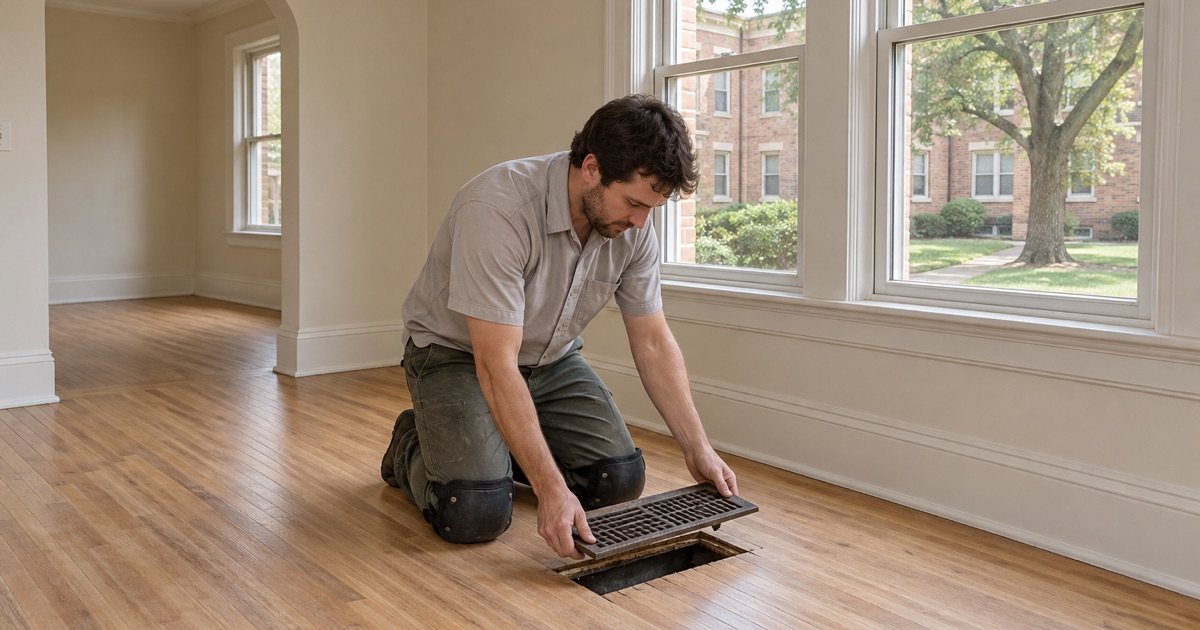
For us, a staggered build-out means we never assume a floor from the house next door. We pull a floor vent or look at a threshold to see board width, thickness and how the boards are fastened. We check for earlier sanding passes that have thinned the wear surface, and we note any patches where a wall, a closet or a radiator once stood.
What National Register Listing Means for a Floor Job
Listing on the National Register recognizes the district’s history; it is not the same thing as a city historic designation. Virginia–Highland does not appear on the published list of City of Atlanta local designations, and we do not assert any local design review for the neighborhood. Permits, zoning and historic questions here belong to the City of Atlanta.
If you are unsure what applies to your address, the right source is the city or your own paperwork, not a flooring crew. What we can do is document the existing floor before we touch it, keep original boards wherever they can be saved, and tell you plainly when a board is too far gone to sand again.
Lead-Safe Prep in Pre-1978 Homes
In ZCTA 30306, the Census area we use as a labeled proxy for the neighborhood, 40.1 percent of housing units were built before 1940. Federal lead-safe rules under the EPA RRP Rule reach homes built before 1978, so we check the build year and look at painted baseboards, quarter round, stair risers and old shoe molding before any sander runs.
Where painted trim has to come off or be disturbed, we contain the room, keep dust off the floor we are about to finish, and clean up to the standard the rule sets. Dustless sanding with a vacuum-connected drum sander and orbital sander keeps most of the fine dust out of the air in the first place.
Slopes, Retaining Walls and Low Ground
The nomination notes that the district sits higher than much of the surrounding area, and that some sections need brick or stone retaining walls. Orme Park, by contrast, lies in a low-lying area with a small stream. Houses on lower ground or cut into a slope can see more moisture move toward the floor during a humid Georgia summer.
When boards cup, we read them with a moisture meter and find the source before anyone sands the raised edges flat. Sanding a cupped floor while it is still wet leaves it crowned once it dries. We would rather wait for a gutter, a grade problem or a dehumidifier to do its work than sand twice.
Looking for wood-flooring closer to Midtown Atlanta? See Midtown Atlanta Wood-Flooring.
Garden Apartments and Duplexes From 1917 to 1935
The nomination is direct about the multifamily side of the district: “The large collection of apartment buildings and duplexes built between 1917 and 1935 in the district reflects the boom in multifamily housing in Atlanta.” For a flooring contractor, that line describes a whole second category of work that most single-family neighborhoods simply do not have.
Country House, Garden and Hotel-Type Apartments
The nomination names three main types of apartment building in the district: country house-type, garden-type and hotel-type. It cites the 1916 Colonnade Court Apartments and the 1922 St. Charles Apartments as examples, along with garden apartments at 1229 Rosedale Drive and a duplex at 1110 Highland Avenue. The nine-story Briarcliff Hotel, built in 1924-25, served as luxury apartments and a residential hotel.
Each type puts different limits on floor work. A garden apartment may have its own entrance and a short run of rooms, while a hotel-type building means elevators, hallways and neighbors on every side. We ask about access, working hours and where equipment can be staged before we quote, because those answers shape the schedule as much as the floor does.
Refinishing One Unit at a Time
In a duplex or apartment, we usually refinish one unit while the rest of the building stays occupied. That makes dust control and finish choice more than a matter of taste. We choose clear finishes by their federal VOC category under 40 CFR 59 Subpart D, not by the floor-coating number that applies only to opaque coatings, and we explain the cure time for each.
A waterborne polyurethane lets a unit return to light use sooner than an oil-modified polyurethane, while a hardwax oil trades durability for easier spot repair. Where a unit is part of an association, we confirm the association’s written approval before work starts. Any interior flooring rule comes from your own declaration, not from state law, so the document itself is what we read.
Floor Estimates for Landlords
In the ZCTA 30306 proxy, 4,868 of 11,606 occupied units are renter-occupied, so a good share of our calls come from owners turning over a rental. Pet urine stains, traffic lanes worn through the finish, water stains by a kitchen sink and furniture gouges are the usual list after a long tenancy.
We write itemized floor-damage estimates a landlord can set against the move-out inspection list, room by room and repair by repair. That separates normal wear from real damage, shows which boards need replacement and which will sand out, and gives both parties a document to work from rather than a single lump sum.
Bungalows, English Cottages and Foursquares
The nomination lists bungalow, English cottage and American Foursquare as the predominant house types, and Craftsman, English Vernacular Revival and Colonial Revival as the leading styles. These are the houses most owners picture when they think of the neighborhood, and most of them have floors that have been refinished more than once already.
Bungalow Floors and Second-Story Additions
The nomination notes that some historic houses became noncontributing because of alterations such as a new second story added to a one-story bungalow. When a bungalow grows upward, the new floor rarely matches the old one in width, species or finish, and the stair between them becomes a joint that the eye catches immediately.
We blend old and new with careful stain samples and matching sheen levels, and we price the staircase tread by tread rather than by the square foot. Stair treads, risers and nosing each take their own sanding and finishing work, and a new stair is often where a remodeled bungalow either reads as one house or two.
English Cottages and American Foursquares
The nomination observes that the American Foursquare was not as popular in Georgia and is not seen in great numbers, but that the district has good examples. Foursquares and English cottages tend to have more separate rooms than a bungalow, which means more thresholds, more reducers and more places where two floors meet.
We treat each threshold as its own small repair. Loose boards get new flooring cleats, gaps get assessed before anyone fills them, and old patches are woven in with matching stock instead of face-nailed over. Board gapping that opens every winter and closes every summer is usually normal seasonal movement, and we tell you when it is.
Sanding an Old Floor Only as Much as It Needs
Old floors have a limited amount of wood above the tongue, and every full sanding removes some of it. We check that remaining thickness first, then choose a grit sequence that takes off the old finish and the damage without going deeper than necessary. Sometimes a screen and recoat is the right answer.
When a floor does need a full sanding, water popping before the stain helps the color take evenly, especially on darker tones. We lay stain samples on your floor, let them dry, and look at them in morning and evening light before you choose, because a color picked from a showroom card rarely matches what old wood does with it.
Infill Houses on the Old I-485 Lots
The nomination states that most of the district’s noncontributing properties are nonhistoric infill houses built on lots razed for the aborted I-485 highway project. John Howell Park was created on some of the lots the Georgia Department of Transportation cleared for that project. Those infill houses are a separate part of our work here.
Site-Finished Oak From the 1990s and 2000s
In the ZCTA 30306 proxy, 21.2 percent of housing units were built in 2000 or later. Houses from those decades often carry site-finished red oak or white oak that has turned orange, lost its finish in traffic lanes or picked up sun fade by the windows.
We sand and refinish those floors rather than tear them out, after checking how much wood remains above the tongue. A site-finished oak floor in good structural shape can take a new color, a lower sheen level and a harder-wearing finish, and it usually costs far less than a new floor in the same rooms.
From Carpet or Plank to Hardwood
Some infill houses and older rentals still have builder-grade carpet, laminate or luxury vinyl plank that owners want gone. We pull the carpet pad and tack strip, check the subfloor for flatness and moisture, and install solid hardwood or engineered flooring with the proper acclimation and expansion gap.
Stairs are included in that work when you want them. We replace carpeted stairs with new treads and risers, fit the stair nosing to the landing, and finish the whole run to match the new floor so the transition from one level to the next looks planned rather than patched together.
Water Damage and Termite Repairs
A failed supply line or a leaking dishwasher can soak a floor from below in a single afternoon. We trace the water, dry the area, measure the boards with a moisture meter before replacing any, and document the damage room by room for the adjuster.
Where subterranean termites have damaged flooring, we wait until the pest control company has treated, then cut out the affected boards and weave in matching stock. We never fill or cover over termite damage, and when a termite inspection turns up damaged flooring ahead of a sale, we work to the seller’s closing date.
- 20+ Years on Wood Floors
- Moisture Readings Before Sanding
- Stairs Quoted Tread by Tread










